UAE
UAE

Container Farming in India: The Complete Guide to Setup, Crops & Profitability
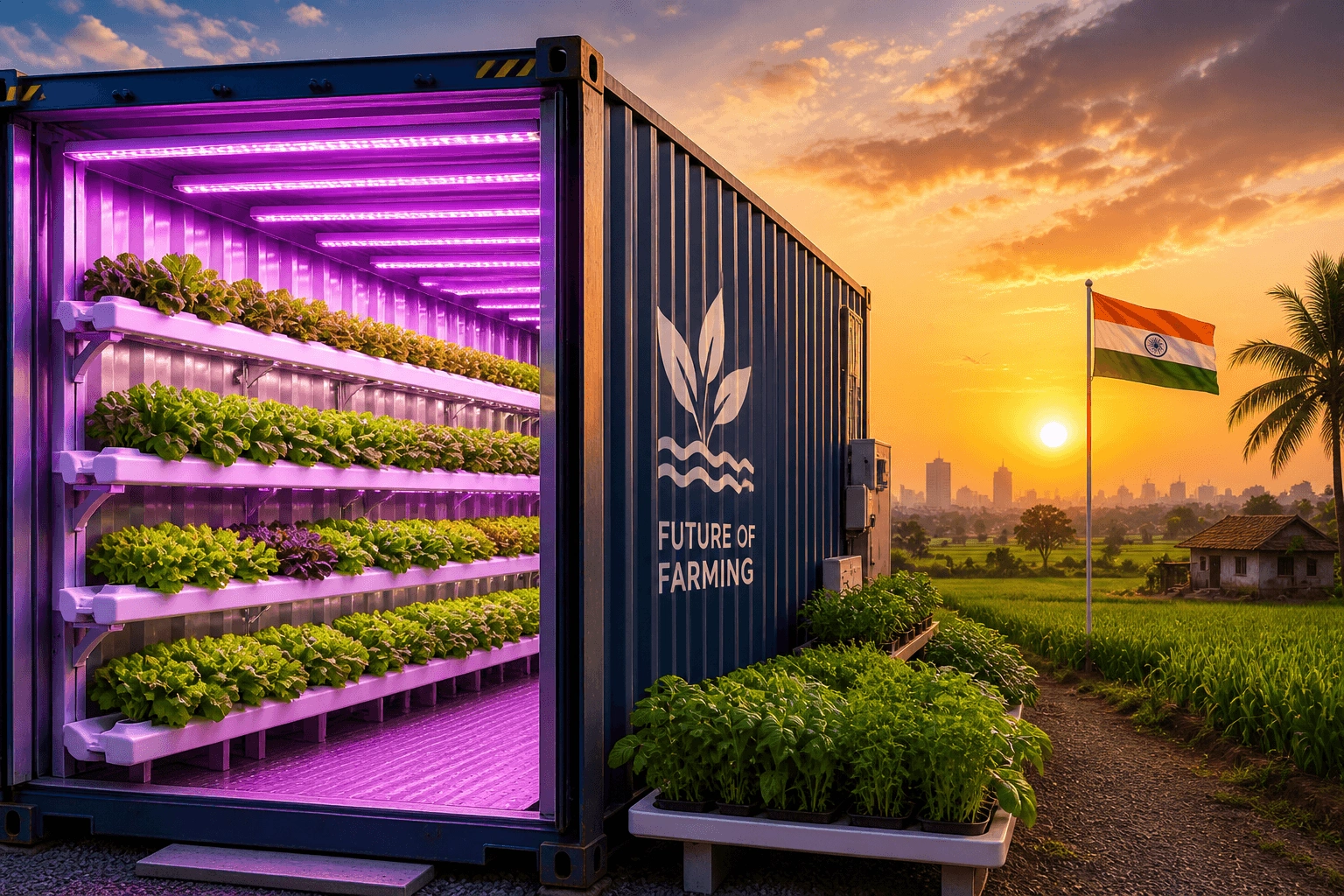
India is at an inflection point. Urbanisation is accelerating, arable land is shrinking, water tables are falling, and a growing middle class is demanding year-round, pesticide-free fresh produce. Container farming — the practice of growing crops inside repurposed or purpose-built shipping containers — is emerging as one of the most compelling answers to this challenge.
Whether you are an entrepreneur looking to enter controlled-environment agriculture, a hotel or restaurant chain seeking a farm-to-fork solution, or an agricultural scientist scaling tissue-culture hardening, container farming offers a scalable, location-independent, and surprisingly capital-efficient model. This guide covers everything you need to know: what container farming is, why India is primed for it, how to set one up, which crops yield the best returns, and what technology — particularly LED grow lights — sits at the heart of every successful container farm.
What Is Container Farming?
Container farming, also called a shipping-container farm or freight-farm, is a form of controlled-environment agriculture (CEA) conducted inside a standard ISO shipping container — most commonly a 20-foot (6m) or 40-foot (12m) unit. The container acts as a self-contained, climate-controlled grow room. Inside, growers install hydroponic or aeroponic growing systems, high-efficiency LED grow lights, temperature and humidity controllers, CO₂ enrichment equipment, nutrient dosing systems, and data sensors — all working together to create the ideal environment for plant growth regardless of what is happening outside.
The concept gained mainstream traction in the United States and Netherlands around 2012–2015 with companies like Freight Farms and Plenty, but adoption in India has accelerated significantly from 2020 onwards as awareness of hydroponics, supply-chain disruptions caused by the pandemic, and falling costs of LED lighting have converged.
Why Container Farming Makes Sense for India
1. Land Scarcity and Urban Demand
India loses approximately 30 lakh hectares of agricultural land every decade to urbanisation and infrastructure development. Meanwhile, urban centres like Bengaluru, Pune, Hyderabad, and the Delhi-NCR region have rapidly growing demand for high-value crops — lettuce, herbs, microgreens, strawberries — that are difficult and expensive to import from distant farms while keeping them fresh.
A single 40-foot container placed on a rooftop, vacant plot, or warehouse floor can produce up to 2–4 kg of leafy greens per day. That is equivalent to roughly half a hectare of traditional open-field production in terms of yield, achieved in a fraction of the space.
2. Extreme Climate Variability
India's agricultural zones span tropical, semi-arid, arid, and cold-desert climates. Temperature extremes, unseasonal rains, and prolonged heat waves make reliable open-field cultivation of premium produce near impossible across most of the country for large parts of the year. Container farms eliminate weather as a variable entirely — the same container growing baby spinach in Bengaluru in July operates identically to one growing the same crop in Leh in January.
3. Water Crisis
India accounts for roughly 18% of the world's population but only 4% of its freshwater resources. Agriculture consumes over 80% of available freshwater. Hydroponic container farms use 90–95% less water than equivalent soil-based farming because water is recirculated through closed-loop nutrient systems, with losses limited to transpiration and minor drainage.
4. Rising Demand for Premium and Organic Produce
India's organic food market was valued at approximately USD 1.3 billion in 2023 and is projected to grow at over 20% annually through 2028. Container-grown produce is inherently free from soil-borne pathogens, pesticides, and most herbicides — making it ideally positioned to serve the premium and organic segments of organised retail, quick-service restaurants, hotel chains, and direct-to-consumer subscription boxes.
5. Government and Institutional Support
The Indian government's focus on doubling farmer income, the National Horticulture Mission, NABARD's interest-subvention schemes for precision agriculture, and state-level agri-tech policies in Karnataka, Maharashtra, Andhra Pradesh, and Gujarat have created a favourable policy environment. Several agri-tech incubators — including those run by IIT Bombay, ICAR, and MANAGE — now actively support CEA start-ups.
How to Set Up a Container Farm in India: Step-by-Step
Step 1: Choose Your Container
Standard ISO shipping containers come in two sizes commonly used for farming: 20-foot (20ft × 8ft × 8.5ft, ~15 sq m floor area) and 40-foot (40ft × 8ft × 8.5ft, ~30 sq m floor area). High-cube 9.5-foot tall variants are preferred because they allow more vertical growing tiers. When sourcing containers in India, look for CSC-certified units with no prior chemical cargo and verify for structural integrity, moisture sealing, and ventilation port compatibility. Many container-farm operators in India source used containers from ports in Chennai, Mumbai, and JNPT for ₹1.5–3.5 lakh depending on condition and size.
Step 2: Insulation and Climate Control
Shipping containers are metal boxes — they absorb and radiate heat rapidly. In Indian climates, adequate insulation is non-negotiable. Typically, 50–75 mm of PUF (polyurethane foam) panels are used to line interior walls and ceiling. An appropriately sized split AC or HVAC unit maintains internal temperatures between 18–26°C depending on the crop. For farms in the Indian plains, a 1.5-tonne inverter AC per growing bay is a reasonable starting point. CO₂ enrichment can increase yields by 20–30% and is increasingly common in premium setups.
Step 3: Hydroponic System Selection
Most container farms in India use one of three hydroponic systems:
NFT (Nutrient Film Technique) — Ideal for leafy greens and herbs. A thin film of nutrient solution flows continuously over plant roots in sloped channels. Low water volume, easy to manage.
DWC (Deep Water Culture) — Plants are suspended over a reservoir of oxygenated nutrient solution. Good for fast-growing lettuces and spinach. Requires reliable air pumps.
Vertical ZipGrow or Tower Systems — Maximise vertical space. Excellent for herbs, microgreens, and baby leaves. Reduces footprint by 40–60% vs. flat NFT layouts.
For a 40-foot container, a well-designed NFT or vertical system can accommodate 1,000–2,000 plant sites. Microgreens trays, which have a shorter turnaround of 7–14 days, can dramatically improve the revenue-per-square-foot metrics.
Step 4: LED Grow Lights — The Most Critical Investment
This is where the success or failure of a container farm is most often determined. Plants in a sealed container have no access to sunlight. Artificial lighting must replicate the full photosynthetically active radiation (PAR) spectrum that plants need for vegetative growth and — depending on the crop — for flowering and fruiting. Incandescent or fluorescent lights are completely inadequate for commercial-scale container farming. High-pressure sodium (HPS) lights produce the right output but generate enormous heat loads, consume significantly more energy, and have much shorter lifespans.
High-efficiency LED grow lights are the industry standard today, and for Indian container farmers operating on narrow margins, the energy savings and longevity of LEDs are not optional luxuries — they are financial necessities.
Key Insight: A poorly lit container farm is not a farm — it is an expensive storage unit. Choosing the right spectrum and wattage of LED grow light for each crop type is the single most impactful technical decision you will make.
For container farms growing leafy vegetables on NFT or vertical tower systems, Nexsel Tech's purpose-built hydroponics grow lights are specifically engineered for this environment. The range is designed for Indian voltage standards (220–240V, 50Hz), high ambient temperatures, and continuous 16-hour photoperiods.
For small to medium container setups (single-tier or two-tier NFT channels in a 20-foot container), the 2FT 9W Grow Light for Leafy Vegetables offers a compact, energy-efficient solution that delivers the precise Nx1.1 or Nx4 spectrum your lettuce, spinach, and kale need to reach harvest weight in 21–28 days.
For larger 40-foot containers with multiple growing tiers, the 4FT 36W Grow Light for Leafy Vegetables provides the PPFD levels needed to sustain vigorous vegetative growth across wider growing channels, reducing the number of fixture units required and simplifying your electrical layout.
Container farms that dedicate a section to microgreens will find the 4FT 18W Grow Light for Microgreens especially effective. Engineered for the Nx6.2 spectrum that accelerates germination and rapid shoot development, it is ideal for the tight growing trays and short 7–14 day cycles that make microgreens so profitable.
Step 5: Nutrient Management and Water Quality
Hydroponics is fundamentally about delivering the right nutrients to the right root zone at the right concentration and pH. In India, water quality varies enormously by region. Before sizing your nutrient system, always test your source water for TDS (total dissolved solids), pH, hardness, and microbial load. Most container farms require a basic RO filtration unit to bring source water TDS below 100 ppm before blending nutrient solutions. Target EC (electrical conductivity) ranges from 1.2–2.0 mS/cm for leafy greens and herbs, and pH should be maintained between 5.8–6.5.
Step 6: Automation and Monitoring
Modern container farms increasingly use IoT sensors connected to a central controller or cloud dashboard to monitor and automate temperature, humidity, CO₂, EC, pH, and lighting schedules. Entry-level automation setups using off-the-shelf Arduino or Raspberry Pi controllers with EC/pH probes and relay boards are available from Indian vendors for under ₹50,000. Mid-range commercial systems from providers like Priva, Hortimax, or Indian start-ups like Clover Leaf and Kheyti offer more robust solutions.
Best Crops for Container Farming in India
Not every crop is well-suited to container farming. The economics only work when you are growing high-value produce that has a short growth cycle, strong local demand, and benefits from the freshness and consistency that controlled-environment production provides.
1. Leafy Vegetables and Herbs
Lettuces (Butterhead, Romaine, Lollo Rosso), baby spinach, arugula, basil, coriander, mint, and chives are the backbone crops of container farming globally, and India is no exception. These crops have 21–35 day harvest cycles, tolerate the 16–18 hour artificial photoperiods well, and command premium prices of ₹200–600/kg in organised retail and food-service channels.
A stack of NFT channels lit by the 4FT 18W Grow Light for Leafy Vegetables can cycle through 5–6 harvests per growing bay per month, making leafy greens the most reliable revenue engine in your container farm. The Nx1.1 and Nx4 spectrums are optimised for the compact canopy architecture of hydroponic lettuce and spinach.
2. Microgreens
Microgreens — the young seedlings of sunflower, radish, pea shoots, wheat grass, mustard, and 50+ other species — are harvested at 7–14 days and sell at ₹600–2,500/kg depending on variety and channel. They require minimal growing depth, produce no waste roots to manage, and can be grown on simple trays on multi-tier racking systems. A well-managed microgreens section in a 40-foot container can generate ₹1.5–3 lakh/month in revenue alone.
For microgreens production, Nexsel's 2FT 9W Grow Light for Microgreens and 4FT 18W Grow Light for Microgreens are available in the Nx6.2 spectrum — a proprietary formulation that promotes rapid hypocotyl elongation and dense cotyledon development, giving you a visually appealing, nutrient-dense product that commands premium positioning with chefs and health retailers.
3. Strawberries
Growing strawberries in India has traditionally been confined to hill stations like Mahabaleshwar, Ooty, and Nainital. Container farming changes this equation entirely. With precise temperature control (maintaining 15–22°C during fruiting) and controlled daylength management, strawberries can now be grown year-round in climate-controlled containers anywhere in the country — in Mumbai in June, in Chennai in October, in Jaipur in May.
The 4FT 36W Grow Light for Strawberry from Nexsel is specifically engineered for the photoperiod and spectral requirements of strawberry cultivation — combining blue-spectrum promotion for compact vegetative growth with red-spectrum intensity to trigger flowering and fruit development. This is one of the more technically demanding crops for container farming, but also one of the highest-value, retailing at ₹300–800/kg in peak demand periods.
4. Saffron
Perhaps the most exciting prospect for high-value container farming in India is saffron. India's saffron production is almost entirely concentrated in the Kashmir Valley (Pampore), and annual production has fallen from over 15 MT in the 1990s to under 5 MT in recent years due to climate change and land conversion. Saffron commands ₹2–3 lakh per kilogram, making it one of the most expensive agricultural commodities in the world.
Controlled-environment saffron cultivation using corm induction and vertical growing systems has been demonstrated successfully in labs and pilot farms. Nexsel's 4FT 18W Grow Light for Saffron is purpose-formulated for the specific light spectra and photoperiod cycles that trigger corm dormancy break, vegetative growth, and the critical flowering phase in Crocus sativus — making saffron container farming a commercially viable proposition for the first time outside of traditional growing regions.
5. Tissue Culture Hardening
This is an often-overlooked but commercially important application. Large-scale banana, sugarcane, teak, bamboo, and ornamental plant nurseries in India propagate millions of tissue-culture (TC) plantlets annually. The critical bottleneck is the acclimatisation or "hardening" stage, where sterile lab-grown plantlets must be transitioned to ambient conditions — a process requiring extremely precise, consistent light intensity and photoperiod to avoid mass loss.
A container farm configured specifically as a TC hardening chamber, using Nexsel's 2FT 9W Grow Light for Tissue Culture for early-stage plantlets and the 4FT 18W Grow Light for Tissue Culture for later hardening stages, allows nurseries to maintain survival rates above 90% across batches — dramatically improving the economics of TC propagation at commercial scale.
Container Farm Setup Costs and ROI in India (2025 Estimates)
One of the most frequent questions from aspiring container farmers is "how much does it cost?" The honest answer is: it depends heavily on your crop mix, automation level, container size, and location. The following is a realistic breakdown for a single 40-foot container farm focused on leafy greens and microgreens.
Capital Expenditure (One-Time Setup)
Container (40ft used, CSC certified): ₹2.5–3.5 lakh
Insulation (PUF panels, 50mm): ₹1.5–2.5 lakh
HVAC / Climate Control (1.5T inverter AC × 2): ₹1.5–2 lakh
LED Grow Lights (20–30 fixtures): ₹1.5–3 lakh (varies by wattage and fixture count)
NFT/Hydroponic System (channels, pumps, reservoirs): ₹1–2 lakh
Electrical wiring, MCBs, timers, power backup: ₹0.75–1.5 lakh
Nutrient dosing system + RO unit: ₹0.5–1 lakh
Sensors, controllers, basic automation: ₹0.5–1 lakh
Miscellaneous (grow media, initial nutrients, transport): ₹0.3–0.5 lakh
Total CapEx Range: approximately ₹10–17 lakh for a fully operational 40-foot container farm. This is not a small investment, but it is substantially less than the ₹50–150 lakh cost of building a comparable area of permanent polyhouse or glass greenhouse infrastructure — and it is mobile, scalable, and depreciable.
Operational Expenditure (Monthly)
Electricity (16h photoperiod + HVAC): ₹8,000–18,000 depending on local tariff and AC load
Nutrients and growing media: ₹3,000–8,000
Seeds/Corms/Plugs: ₹1,000–3,000
Labour (1 part-time or 1 full-time operator): ₹8,000–18,000
Packaging, logistics, marketing: ₹3,000–8,000
Total Monthly OpEx: approximately ₹23,000–55,000 for a single 40-foot unit.
Revenue Potential
A well-managed 40-foot container producing leafy greens can yield 50–80 kg/week of harvested produce. At a conservative farm-gate price of ₹200/kg (wholesale to restaurants and retailers), this is ₹40,000–64,000/week, or ₹1.6–2.5 lakh/month. At premium direct-to-consumer prices (₹350–600/kg), revenue can reach ₹3–5 lakh/month. Adding a microgreens section can add ₹1–3 lakh/month at current market prices.
Payback Period: Most single-container farms in India report payback periods of 18–36 months on the base setup. Operators who combine multiple crops (leafy greens + microgreens + a premium crop like strawberry or saffron) and have established direct-to-consumer or institutional buyer relationships can achieve payback in 12–18 months.
Challenges of Container Farming in India
Container farming is not without its challenges in the Indian context. Understanding these upfront allows you to plan mitigation strategies rather than discover them expensively mid-operation.
1. High Electricity Costs
Electricity tariffs for commercial and industrial consumers in India range from ₹5 to ₹12 per unit (kWh) depending on the state. With grow lights running 16 hours a day and HVAC systems working against India's ambient temperatures, electricity is typically the largest operating cost. Selecting energy-efficient LED fixtures — rather than HPS or CMH lights — is therefore not just an environmental preference but a financial imperative. Every watt saved in lighting directly reduces your break-even timeline.
2. Technical Knowledge Gap
Successful container farming requires competency in plant science, hydroponics chemistry, electrical systems, HVAC, and basic data analysis. This knowledge profile does not exist in most traditional farming communities. Agri-tech companies, ICAR extension services, and private consultants are beginning to bridge this gap, but it remains a significant barrier to entry for first-generation container farmers in Tier 2 and Tier 3 cities.
3. Market Access and Pricing
Growing premium produce is only half the challenge — selling it profitably is the other half. Container-grown produce competes at the premium end of the market, where buyers include hotels, QSRs, cloud kitchens, and direct consumers. Building these sales relationships takes time and marketing investment. Container farmers who enter without a clear go-to-market strategy risk being forced to sell at commodity prices, which quickly destroys the economics.
4. Regulatory and Import Complexities
Several components of a modern container farm — LED drivers, specialised grow light fixtures, advanced hydroponic controllers — may be imported, attracting customs duties of 18–28% under India's current tariff schedules. Sourcing from domestic manufacturers where possible reduces these costs and simplifies maintenance logistics. Nexsel Tech's grow lights are manufactured in India, making them a practical choice for minimising import dependency and ensuring availability of spare parts and technical support within the country.
5. Perception and Consumer Education
A meaningful segment of Indian consumers still associates "hydroponic" or "indoor-grown" produce with artificial or chemically treated food — the exact opposite of reality. Container farms produce cleaner, more nutritious, and more consistently fresh produce than most supply chains in India. Educating your target consumer base through farm visits, social media transparency, and credible certification (FSSAI organic/hydroponic category, GlobalG.A.P.) is an investment that pays back through customer loyalty and premium pricing power.
Choosing the Right LED Grow Lights for Your Container Farm
The grow light selection decision is the single most technically consequential choice in your container farm build. Here is a practical framework for choosing correctly, followed by specific recommendations for common Indian container-farm configurations.
Understanding PAR, PPFD, and DLI
Three metrics matter most when evaluating grow lights for container farming:
PAR (Photosynthetically Active Radiation): The wavelength range (400–700 nm) of light that plants use for photosynthesis.
PPFD (Photosynthetic Photon Flux Density): The intensity of PAR light falling on the canopy surface, measured in μmol/m²/s. Leafy greens thrive at 150–250 μmol/m²/s; fruiting crops like strawberries need 350–600 μmol/m²/s.
DLI (Daily Light Integral): Total PAR light received per day (mol/m²/day). Most container crops require a DLI of 12–20 for vegetative crops and 20–35 for fruiting crops.
When comparing grow light options, always ask for PPFD maps at your actual mounting height, not just peak values. A fixture that achieves 500 μmol/m²/s at 15 cm but drops to 80 μmol/m²/s at 30 cm is not suitable for deep-canopy leafy green production.
Spectrum Selection
Different crops at different growth stages respond differently to light spectrum. The key spectrums in Nexsel's grow light range are:
Nx1.1: A balanced full-spectrum formulation ideal for general leafy vegetable and herb production, providing both the blue light (430–460 nm) needed for compact, high-chlorophyll vegetative growth and the red light (620–680 nm) for photosynthetic efficiency.
Nx4: An enhanced spectrum with modified blue-red ratios suitable for crops where more robust vegetative development and faster canopy fill are priorities — including mixed salad crops and Swiss chard.
Nx6.2: Designed for microgreens and seedlings, this spectrum prioritises germination energy and early hypocotyl growth — delivering the rapid, uniform stands that define premium microgreen quality.
Container Farm Lighting Configurations by Setup Type
Setup Type A: Compact 20-Foot Container (Leafy Greens, Single Crop)
Fixtures: 2FT 9W Grow Light for Leafy Vegetables — mount 1 fixture per 2-foot growing channel section. For a 20-foot container with 3 tiers at 2-foot wide: approximately 30 fixtures total.
Estimated daily electricity use: ~4.3 kWh at 16h photoperiod
Monthly electricity cost: ₹2,500–4,500 at Indian commercial tariff
Setup Type B: 40-Foot Container (Leafy Greens + Microgreens, Mixed Production)
This is the most common entry configuration for commercial container farms in India: two main growing bays separated by a central walkway.
Bay 1 (Leafy Greens): 4FT 18W Grow Light for Leafy Vegetables — fewer fixtures, wider coverage, suitable for deep-canopy crops like butter lettuce and spinach.
Bay 2 (Microgreens): 4FT 18W Grow Light for Microgreens — Nx6.2 spectrum fixtures on dense multi-tier tray racking. 12–16 fixtures for a full microgreens section.
Combined estimated daily electricity use: ~14 kWh at 16h photoperiod
Monthly electricity cost: ₹8,000–15,000 depending on state tariff
Setup Type C: Premium 40-Foot Container (Strawberry Production)
Strawberry container farming requires the most precise light management. Plants need a vegetative photoperiod of 16–18 hours followed by a short-day flowering trigger at 12 hours, and specific spectral ratios to set fruit uniformly.
Fixtures: 4FT 36W Grow Light for Strawberry — engineered for this specific photoperiod and spectral requirement. Higher wattage per fixture is justified by the significantly higher revenue per kilogram of strawberry vs. leafy greens (₹300–800/kg vs. ₹150–350/kg).
Setup Type D: Saffron Cultivation Container
For operators exploring high-value saffron cultivation, the container must be configured for the unique requirements of Crocus sativus: a precise cold period (10–15°C) to break corm dormancy, followed by a warm flowering phase (15–20°C), with carefully controlled photoperiods.
Fixtures: 4FT 18W Grow Light for Saffron — the purpose-formulated spectrum for Crocus sativus vegetative and flowering phases. One of the few LED grow light products on the Indian market specifically calibrated for saffron production.
Setup Type E: Tissue Culture Hardening Chamber
A container configured as a TC hardening facility provides multiple controlled-light zones at different intensities, transitioning plantlets from very low light (50–80 μmol/m²/s) up to ambient-equivalent levels (250–350 μmol/m²/s) over 15–30 days.
Zone 1 (early hardening): 2FT 9W Grow Light for Tissue Culture — gentle, consistent light output appropriate for recently transferred plantlets.
Zone 2 (late hardening): 4FT 18W Grow Light for Tissue Culture — higher output for the final acclimatisation phase before field or polyhouse transfer.
Who Should Consider Container Farming in India?
Container farming is not universally suitable for every agricultural business — but it is remarkably well-suited to a wide range of operators who share the common need for year-round, location-independent, high-quality produce production.
Entrepreneurs and agri-tech start-ups: If you are exploring CEA as a business model, a single-container pilot is the most capital-efficient way to validate your crop mix, market relationships, and operational competency before committing to a large polyhouse or multi-container farm.
Hotels, resorts, and restaurant chains: Farm-to-fork is no longer just a marketing claim — it is a competitive differentiator. A container farm on-premises or in a nearby location guarantees freshness, traceability, and the ability to serve hyper-seasonal specialty crops year-round.
Corporate campuses and institutions: Several IT parks and campuses in Bengaluru, Hyderabad, and Pune are exploring container farms to supply their cafeterias with fresh produce while reducing supply chain risk and transportation costs.
Plant nurseries and tissue culture labs: The ability to harden TC plantlets at scale, year-round, in a controlled environment has direct commercial value for nurseries propagating high-value plants like banana, orchids, teak, and bamboo.
Research institutions and agricultural universities: A container farm provides a repeatable, controlled research environment for plant science experiments — far more consistent than field trials or conventional greenhouses.
Defence and remote installations: Self-sufficient fresh produce supply at remote Army, Navy, or CRPF installations — where fresh vegetable supply chains are expensive and unreliable — is an increasingly discussed application.
Frequently Asked Questions About Container Farming in India
Is container farming legal in India?
Yes. Container farming is legal in India. It is subject to standard commercial establishment regulations, FSSAI licensing if produce is sold commercially, and local municipal approvals for structure placement (similar to any temporary structure or container installation). There is no specific container farm legislation; operators typically fall under existing provisions for food business operators and controlled-environment agriculture.
How much space is needed outside the container?
The container itself occupies its footprint (20ft × 8ft or 40ft × 8ft). You need additional clearance space of 1–2 metres around the container for ventilation exhaust, door operation, and maintenance access. Most rooftop or warehouse installations in Indian cities are able to accommodate this. Unlike greenhouses, containers require no soil preparation and can be placed on any structurally adequate flat surface.
Can container farming be done without electricity from the grid?
Technically yes, but practically challenging at scale. Some pilot projects in India have attempted solar-powered container farms using high-capacity lithium battery banks and bifacial solar panels. The economics are currently challenging because of the high power draw of combined HVAC and grow lighting, but as solar panel costs continue to fall and battery storage costs decline, off-grid container farming will become increasingly viable by 2027–2030.
What crops cannot be grown in container farms?
Container farming is generally not suitable for field crops (wheat, rice, sugarcane), large fruit trees, crops that require deep soil profiles (potatoes, root vegetables at commercial scale), or crops where economics do not justify the controlled-environment premium. Crops like cotton, maize, and groundnut have commodity prices too low to justify the operational costs of a container farm. Container farming is best reserved for high-value crops with short cycles and strong local market demand.
How do I find buyers for container-grown produce in India?
The most successful container farmers in India have direct institutional relationships: contracts with hotels and restaurant groups (via their purchase departments), subscriptions with corporate campuses, partnerships with modern retail (Nature's Basket, Godrej Nature's Basket, BigBasket's premium categories), and direct-to-consumer subscription boxes via platforms like Milkbasket or WhatsApp-based local farm communities. Start with one or two anchor buyers before scaling container count.
Are Nexsel grow lights available across India?
Yes. Nexsel Tech is an India-based manufacturer of LED grow lights, supplying operators across India including those in Bengaluru, Mumbai, Hyderabad, Pune, Delhi-NCR, and increasingly in Tier 2 markets like Coimbatore, Indore, and Bhubaneswar. Their product range covers the full spectrum of container farming needs — from leafy vegetable and microgreens production to saffron, strawberry, and tissue culture applications.
The Future of Container Farming in India
The convergence of several forces — falling LED costs, rising urban food demand, climate unpredictability, improved availability of hydroponic components from domestic manufacturers, and growing investor interest in agri-tech — means container farming in India is not a niche experiment. It is a rapidly maturing commercial sector that will form a meaningful part of India's urban food infrastructure over the next decade.
The farms that will succeed are those that treat container farming as an engineering and business problem with equal seriousness: optimising every watt of grow light energy, every litre of water in the nutrient loop, every kilogram of produce against its market price, and every customer relationship against long-term loyalty. The technology — from the container shell to the LED fixtures that light every plant inside — is now mature enough in India to support that ambition.
If you are ready to start, explore the full range of purpose-built LED grow lights for Indian container farms at Nexsel Tech's hydroponics grow lights collection — engineered specifically for the spectrum requirements, voltage standards, and operating conditions that Indian container farmers face.
Author Note: This guide is based on publicly available data on container farming costs, crop economics, and hydroponic technology as of 2025. Individual results will vary significantly based on location, crop selection, market access, and operational execution. Always conduct thorough due diligence and, where appropriate, consult with experienced CEA practitioners before committing capital.