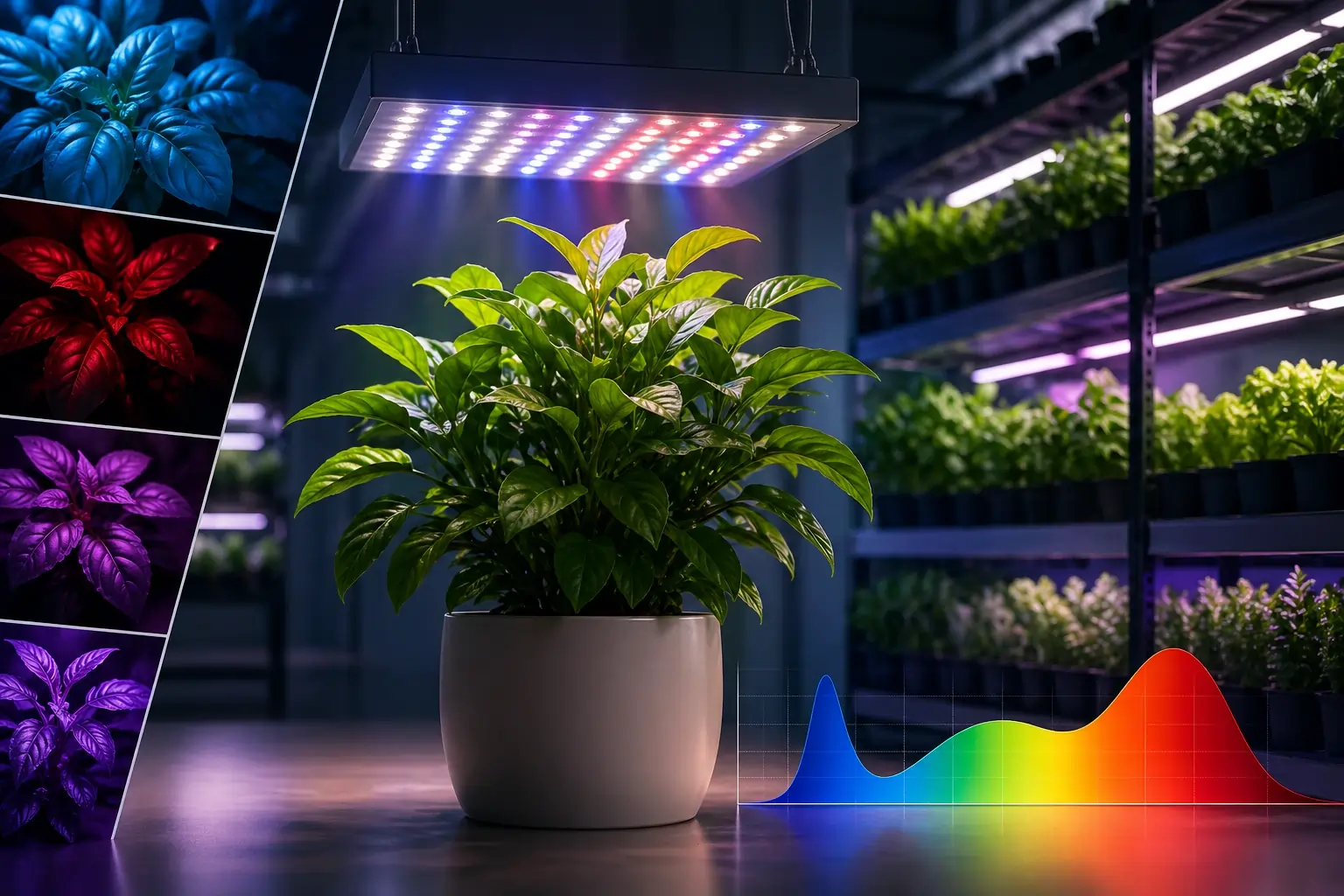
In the world of vertical farming, electricity isn’t just a utility—it’s the largest line item on the balance sheet. With 50–60% of total operational costs tied to power consumption, and up to 80% of electricity fueling the lights, the efficiency of a single LED chip can make or break a farm’s profitability.
A decade ago, the math for indoor farming was a struggle. Today, thanks to a massive leap in Photosynthetic Photon Efficacy (PPE), the industry is hitting a tipping point.
The Decade Leap: 2014 vs. Today
Looking back at the landmark 2014 study by Nelson & Bugbee, the “state-of-the-art” chips of the time look primitive compared to the hardware we use in 2026. On average, we have seen a 40–80% improvement in how effectively chips convert electrons into growth-driving photons.
| Light Spectrum | 2014 Efficiency (µmol/J) | 2026 Efficiency (µmol/J) |
|---|---|---|
| Red (660 nm) | ~2.0 | 3.6 – 4.8 |
| Blue (450 nm) | ~2.0 – 2.2 | 2.8 – 3.5 |
| Far-Red (730 nm) | ~0.7 – 0.8 | 3.5 – 4.5 |
| White | ~1.5 – 1.7 | 3.0 – 3.6 |
Why is This Happening? The Tech Behind the Glow
This isn’t just “better bulbs.” It’s a fundamental shift in semiconductor physics and manufacturing. Five key drivers have pushed PPE to these new heights:
GaN (Gallium Nitride) Improvements: Better material growth technology allows for fewer defects in the crystal lattice of the LED.
Higher Quantum Efficiency: More electrons are successfully converted into photons rather than being “lost” inside the chip.
Reduced Heat Losses: Lower thermal resistance means more energy goes toward light and less toward heating the room (which also lowers cooling costs!).
Advanced Packaging: Modern housing for LED chips reflects more light outward and protects the diode from degradation.
Improved Phosphor Conversion: For white LEDs, the process of converting blue light into a full spectrum has become significantly more precise and less wasteful.
Why PPE Matters for Your Bottom Line
In simple terms, Photon Efficiency (PPE) measures how many useful plant photons you get per watt of electricity.
The Formula for Profit: Higher PPE = Lower Watts = Reduced OpEx.
Even a 5% increase in chip efficiency can save a commercial vertical farm thousands of dollars a month. As the PPE continues to climb, “Plant Factories” that once seemed too expensive to run are becoming the most viable way to feed a growing urban population.
The Future of Indoor Cultivation
The trend is clear: technology is outstripping the limitations of traditional farming. As we move toward the next decade of innovation, we aren’t just growing plants; we are perfecting the physics of life. The future of the plant factory is bright, efficient, and—most importantly—sustainable.
How Grow Light Beam Angle and Mounting Height Affect Plant Growth
In the world of indoor cultivation, we often hear that “Light is Food.” If that’s true, then the beam angle is the spoon. You can have the most nutritious meal in the world, but if the spoon is too wide or the aim is off, half the nutrition ends up on the floor.
For vertical farms and commercial greenhouses, the physics of how light leaves the fixture—and where it lands—is just as important as the LED chip itself. Here is how to master the geometry of plant grow lights to ensure every photon counts.
1. The Inverse Relationship: Mounting Height vs. Beam Angle
The “gap” (the distance between your light source and the plant canopy) dictates your optical strategy. Light naturally spreads as it travels; the goal is to contain that spread within the leaf zone.
• High Mounting Heights: As the gap increases, you must narrow the beam angle. A narrow beam acts like a spotlight, punching the photons down to the canopy without letting them bleed out into the aisles.
• Close Canopy Lighting: In tight vertical racks where the light is only inches from the plants, a wider beam angle is superior. This ensures the light spreads quickly enough to cover the entire bed surface uniformly without creating “hot spots.”
2. The “Room Effect”: Rack Density and Light Spillage
Your choice of artificial lights should change based on your room’s layout. Photons don’t just disappear when they miss a plant; they hit walls and floors, turning into wasted heat and wasted money.
• Single or Double Rack Setups : If you are running only 1–2 racks in a room, you have no “safety net” for spilled light. In this scenario, smaller beam angles are mandatory. Any light that escapes the rack is a 100% loss.
• High-Density Multi-Rack Facilities : In a large-scale plant factory where racks are packed closely together, you can afford a wider beam angle. Why? Because the “spill” from one rack often lands on the neighbor rack. This “cross-lighting” can actually improve light uniformity across the entire facility, provided the racks are positioned to catch the overlap.
3. Directional Geometry: The 4×10 Rule
Even with the perfect chip and the perfect lens, installation direction can be the difference between profit and loss.
Consider a standard growing bed of 4 ft × 10 ft. To maximize Photon Utilization, lights should typically be installed parallel to the shorter (4 ft) side.
Why this matters:
• Uniformity: It ensures a more even “blanket” of light across the long axis.
• Waste Reduction: It minimizes the amount of light overshooting the edges of the 10 ft length.
• Shadow Reduction: It provides multiple angles of light entry into the canopy, reaching the lower leaves more effectively.
The Bottom Line: Geometry Equals Economy
In a plant factory, small technical decisions create a massive economic ripple effect. Choosing the right beam angle, mounting height, and installation direction results in Better Photon Utilization.
When you improve utilization, you get more growth per watt. In an industry where electricity can account for 60% of operating costs, mastering the beam angle isn’t just “good science”—it’s a business necessity.
Optimize your optics, and your plants (and balance sheet) will thank you.
#GrowLights #VerticalFarming #AgriTech #PlantGrowLights #Innovation #Nexsel
Why Tip Burn Happens Under Grow Lights (And It’s Not a Calcium Shortage)
“My leaves are burning at the tips under the lights. What is the reason?”
This is one of the most common questions we receive. At first glance, tip burn looks exactly like a classic calcium deficiency. But here is the secret that many indoor growers miss: The calcium is likely already in your water; it just isn’t reaching the leaves.
In high-tech plant factories, tip burn is rarely a nutrition problem—it is an environmental management problem.
What is Tip Burn, Really?
Tip burn is the death of plant tissue at the edges of new growth. While it is caused by a lack of calcium in those specific cells, the root cause is transportation.
Unlike nitrogen or potassium, Calcium is immobile. It cannot move through the plant on its own. It only moves via transpiration—the process where water is pulled from the roots and evaporates through the leaves.
If water isn’t moving out of the leaf, calcium isn’t moving into it.
The Real Culprit: The “Microclimate”
In vertical farms and indoor grow rooms, the air is often too still. Humidity builds up directly against the leaf surface, creating a stagnant “boundary layer” or microclimate.
When this humid layer sits on the leaf:
Transpiration slows down: The air is too saturated to take in more moisture from the leaf.
Water movement stops: The “suction” from the roots ceases.
Calcium gets stuck: Calcium stays in the stems and roots, never reaching the fast-growing edges of the new leaves.
Tissue Collapses: The new growth burns and dies.
The Risk Equation: High Light Intensity + Low Airflow + High Humidity = Guaranteed Tip Burn.
Practical Solutions for Indoor Growing
1. Improve Airflow (The #1 Priority)
Air movement is the most effective way to “break” the humid boundary layer.
• Horizontal Airflow (HAF): Use fans to create a gentle, continuous breeze across the canopy.
• Vertical Airflow: In rack systems, ensure air is being pushed into the center of the canopy, not just around the sides of the trays.
2. Manage Light and Heat Stress
Powerful grow lights drive fast growth. If the plant grows faster than the calcium can be transported, tip burn occurs.
• Increase the Gap: Raise your lights slightly to reduce the “transpiration demand” on the plant.
• Dim the Lights: Temporarily reduce intensity by 10–15% to allow the plant’s internal systems to catch up.
• Stabilize Temperature: Avoid sudden spikes that force the plant into heat stress.
3. Vapor Pressure Deficit (VPD) Control
Humidity management is about more than just a dehumidifier; it’s about VPD.
• Maintain relative humidity (RH) between 50–70% depending on the crop stage.
• Keeping your VPD in the “sweet spot” ensures the plant’s “internal pump” is always working, moving water and calcium exactly where they need to go.
The Bottom Line
Tip burn is a signal that your environment is out of balance. Before you reach for a bottle of “Cal-Mag,” look at your fans and your humidity sensors. When you balance your airflow, light intensity, and humidity, tip burn disappears, and your plants will thrive.
#VerticalFarming #GrowLights #PlantHealth #AgriTech #ControlledEnvironment #Nexsel
Get Quote
[el_shortcode id="25091"]
Leave A Comment