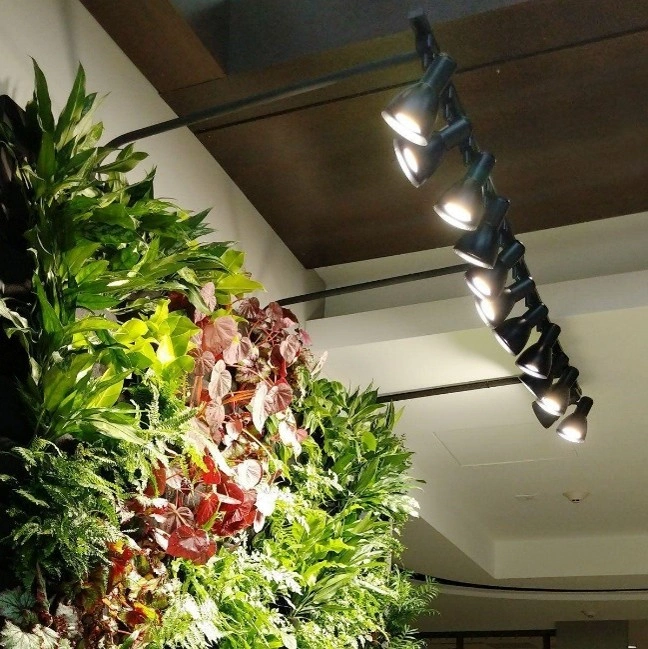
UAE
UAE

Article: Recessed Grow Lights for Plants
Introduction
Indoor landscaping has become a defining feature of modern commercial and residential buildings. Green walls, indoor trees, planter beds, atriums, and biophilic spaces improve visual appeal, occupant well-being, and indoor environmental quality. However, most interior spaces do not receive sufficient natural sunlight throughout the day. As a result, supplemental horticultural lighting has become an essential part of successful indoor plant maintenance.
Recessed grow lights are specifically designed to provide the light required for healthy plant development while remaining hidden within the ceiling. They combine architectural elegance with horticultural performance, making them a preferred solution for hotels, offices, shopping malls, airports, hospitals, restaurants, and premium residences
What are Recessed Grow Lights
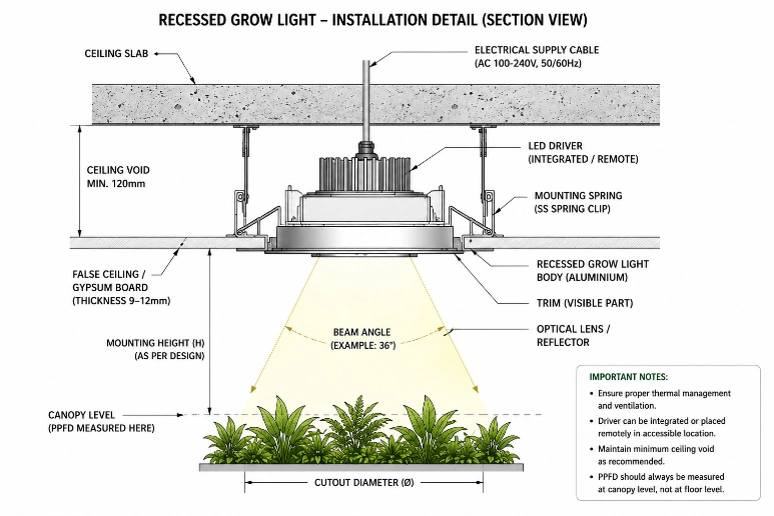
Recessed grow lights are LED luminaires installed flush with the ceiling. Unlike suspended or track-mounted fixtures, they integrate into the architecture, leaving only the trim visible. These luminaires use precision optics to direct photosynthetically active radiation (PAR) onto the plant canopy. Available in fixed and adjustable versions, they can be specified with different beam angles to match plant height, canopy size, and mounting distance
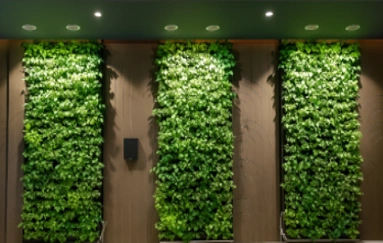
One of the most significant advantages of recessed grow lights is their ability to integrate seamlessly into modern architectural spaces. Since the fixtures are concealed within the ceiling, they maintain clean ceiling lines and eliminate visual clutter, making them an ideal choice for premium interior environments where aesthetics is as important as functionality. Hotels, corporate offices, shopping malls, hospitals, airports, museums, restaurants, luxury residences, educational institutions, and commercial buildings frequently use recessed grow lights to illuminate indoor planters, feature trees, green walls, atriums, and biophilic landscapes without compromising interior design
Working Principle
Plants convert light energy into chemical energy through photosynthesis. Recessed grow lights provide the wavelengths required within the PAR region (400–700 nm). Blue wavelengths promote compact vegetative growth, green light improves canopy penetration, and red light supports photosynthesis efficiency. Full-spectrum LEDs combine these wavelengths to produce healthy plants while maintaining natural leaf colour for occupants
The working principle of recessed grow lights combines LED technology, precision optics, thermal management, and horticultural science to create an efficient artificial lighting system for indoor plants. By delivering the appropriate spectrum, PPFD, and photoperiod while remaining integrated within the ceiling, recessed grow lights support healthy plant growth without compromising the architectural aesthetics of modern interior spaces. This combination of biological performance and architectural integration makes them an ideal solution for professional indoor landscaping projects
Advantages
Concealed installation preserving clean ceiling aesthetics.
Uniform illumination with appropriate beam selection.
Low radiant heat, allowing closer mounting.
Long operating life often exceeding 50,000 hours.
High energy efficiency compared with conventional horticultural lamps.
Reduced maintenance and operating costs.
Lighting Design
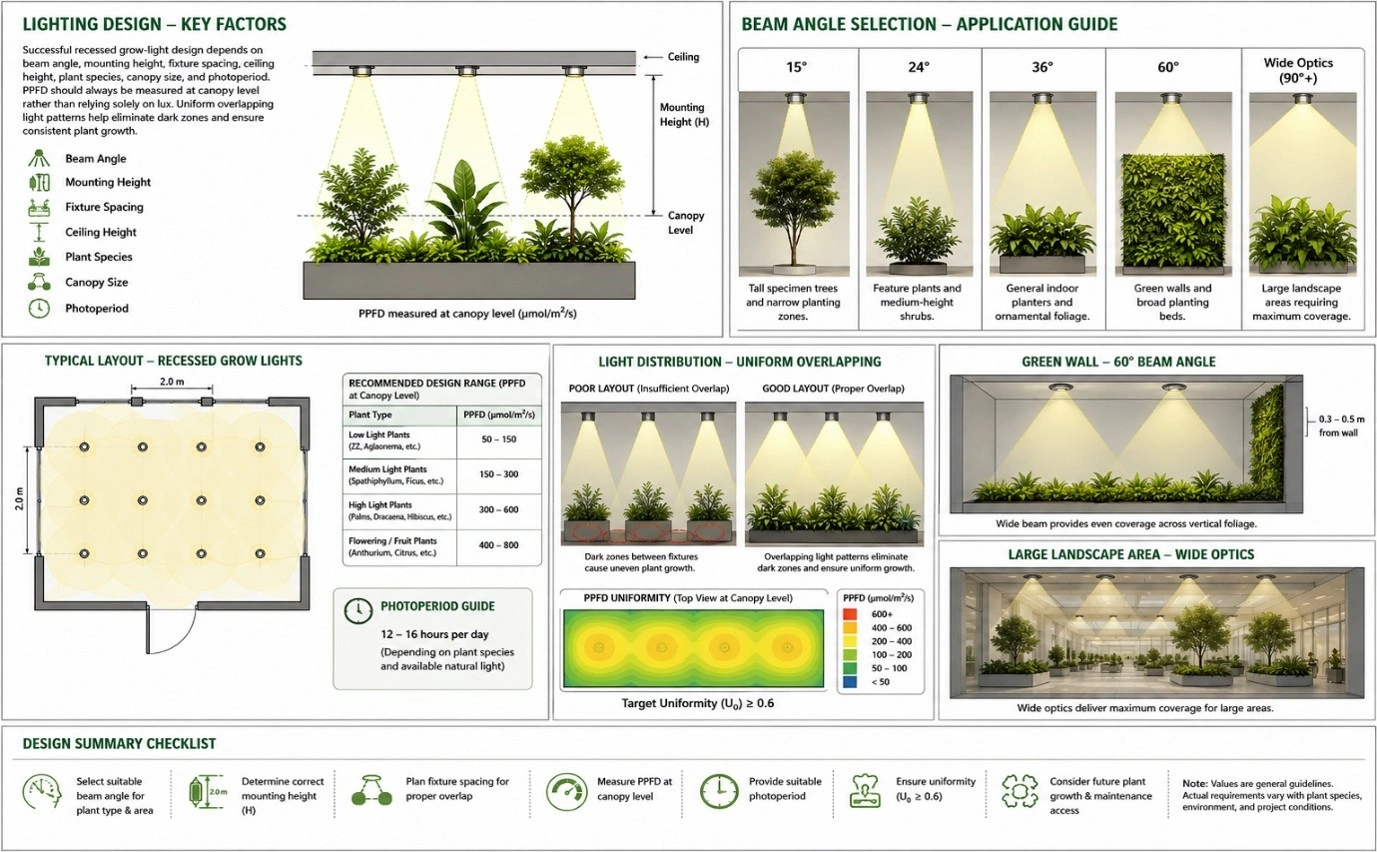
Successful recessed grow-light design depends on beam angle, mounting height, fixture spacing, ceiling height, plant species, canopy size, and photoperiod. PPFD should always be measured at canopy level rather than relying solely on lux. Uniform overlapping light patterns help eliminate dark zones and ensure consistent plant growth
Beam Angle Selection
15°: Tall specimen trees and narrow planting zones.
24°: Feature plants and medium-height shrubs.
36°: General indoor planters and ornamental foliage.
60°: Green walls and broad planting beds.
Wide optics: Large landscape areas requiring maximum coverage.
Applications
Recessed grow lights are suitable for office reception areas, hotel lobbies, luxury residences, shopping malls, airports, hospitals, educational institutions, museums, restaurants, indoor gardens, vertical green walls, atriums, and premium retail displays. Their concealed appearance allows the plants to become the visual highlight
Seamless Architectural Integration: The fixtures are concealed within the ceiling, preserving clean and elegant interiors.
Targeted Plant Illumination: Precision optics direct light to the plant canopy, minimizing light spill and improving efficiency.
Uniform Plant Growth: Proper beam angles and fixture spacing provide consistent PPFD across the planting area.
Visual Comfort: Recessed installation reduces glare and keeps the focus on the landscape rather than the lighting equipment.
Energy Efficiency: LED technology lowers power consumption while providing long operational life and reduced maintenance.
Design Flexibility: Suitable for a wide range of ceiling heights, planting layouts, and architectural styles.
Nexsel Model’s
GWGL 30C
GWGL 50C
PFL C
EAGL 30C
EAGL 50C
Best Practices
Use full-spectrum LEDs, verify PPFD after installation, select beam angles according to canopy geometry, maintain clean optical surfaces, coordinate lighting with irrigation and HVAC systems, and review plant performance periodically to optimize operating schedules.
Design the lighting layout to achieve uniform PPFD distribution across the entire planting area, minimizing hotspots and shadow zones.
Consider the mature plant height and canopy spread during fixture selection to ensure adequate light coverage throughout the plant's growth cycle.
Integrate timers or intelligent lighting control systems to maintain a consistent photoperiod while optimizing energy consumption.
Future Trends
Use full-spectrum LEDs, verify PPFD after installation, select beam angles according to canopy geometry, maintain clean optical surfaces, coordinate lighting with irrigation and HVAC systems, and review plant performance periodically to optimize operating schedules.
Conclusion
Recessed grow lights have emerged as one of the most effective lighting solutions for modern indoor landscaping, combining advanced horticultural lighting technology with contemporary architectural design. As the demand for biophilic spaces continues to grow, maintaining healthy indoor vegetation has become increasingly important in commercial buildings, hospitality projects, healthcare facilities, educational institutions, retail environments, and luxury residences. Since natural daylight is often insufficient in these indoor spaces, recessed grow lights provide the supplemental illumination necessary to support long-term plant health while preserving the visual appeal of the interior.
One of the key advantages of recessed grow lights is their seamless integration into architectural spaces. Their concealed ceiling installation eliminates visual clutter and allows indoor plants to become the primary design feature. This makes them particularly suitable for projects where both aesthetics and functionality are essential. Whether illuminating a feature tree in a hotel lobby, a vertical green wall in a corporate office, or decorative planters in a shopping mall, recessed grow lights provide effective plant lighting without compromising the architectural character of the space.
Reference
Indian Council of Agricultural Research (ICAR). Publications on Protected Cultivation, Ornamental Horticulture, and Controlled Environment Agriculture.
ICAR – Indian Institute of Horticultural Research (IIHR), Bengaluru. Research publications on ornamental plants, indoor landscaping, greenhouse cultivation, and horticultural production.
ICAR – Indian Agricultural Research Institute (IARI), New Delhi. Research publications on protected cultivation, floriculture, landscaping, and crop production.
Sowmya, R., Kurian, C. P., & Narasimhan, S. (2019). Optimization of LED Lighting System for Horticulture Application – A Simulation. This research presents spectrum optimization and LED selection methods for horticultural lighting systems.