UAE

Far-Red LED Ratios to Accelerate the Transition from Vegetative Growth to Flowering
Abstract: The transition from vegetative growth to flowering is a critical developmental phase in horticultural crop production, influencing crop duration, flowering uniformity, and commercial quality. In controlled-environment agriculture, light-emitting diodes (LEDs) provide an opportunity to manipulate this transition by modifying not only light intensity and photoperiod but also spectral composition. Far-red radiation, typically associated with wavelengths around 700–750 nm, can alter phytochrome signalling and influence flowering responses, stem elongation, and plant architecture. In many long-day plants, far-red supplementation and a reduced red-to-far-red (R:FR) ratio can accelerate flowering, although the response depends on species, cultivar, photoperiod, background spectrum, and treatment timing. Research on ornamental crops has demonstrated that far-red supplementation during seedling production can advance flowering in selected long-day species, while studies on Eustoma grandiflorum show that the R:FR ratio can either promote or delay flower development. This article examines the physiological basis of far-red responses, the importance of R:FR ratio and photon flux, practical LED strategies, and the risks associated with excessive far-red exposure. It also outlines an experimental approach for determining suitable far-red treatments for individual crops. The central principle is that far-red lighting should be managed as a developmental signal within a balanced lighting programme, rather than treated as a universal flowering accelerator.
Introduction
Plants use light for two closely related purposes: photosynthesis and environmental signalling. While photosynthetic light supplies the energy needed for growth, the spectral composition of light also communicates information about the surrounding environment. Plants can use these signals to adjust leaf development, stem elongation, branching, and the transition from vegetative to reproductive growth.
Traditional horticultural lighting programmes have largely concentrated on photosynthetic photon flux density (PPFD), daily light integral (DLI), and photoperiod. However, research into light quality has demonstrated that the wavelengths supplied by a lighting system can influence flowering independently of their contribution to photosynthesis.
Far-red radiation has attracted particular interest because of its interaction with the phytochrome photoreceptor system. In certain crops, adding far-red LEDs to a red-and-blue lighting system can advance flowering and reduce the time
required to produce marketable flowers. Nevertheless, the response is not universal. Far-red can also promote excessive stem elongation, change plant architecture, or produce a different flowering response in short-day species.
The objective of this article is to explain how far-red LED treatments can be used to influence flowering, how the R:FR ratio should be interpreted, and how growers can develop a crop-specific lighting strategy supported by measurements and experimental validation.
What is far-red light?
The photosynthetically active radiation (PAR) range is conventionally defined as 400–700 nm. Far-red radiation lies just beyond this traditional range, commonly discussed in horticultural lighting at approximately 700–750 nm, although some experiments and lighting specifications define far-red more broadly.
Red light is commonly associated with wavelengths around 600–700 nm, with 660 nm frequently used in LED experiments. Far-red LEDs often emit around 730 nm.
Far-red is important for two reasons:
Developmental signalling: Far-red changes the state of phytochrome photoreceptors, which influence how plants interpret their light environment.
Photosynthetic interactions: When supplied alongside shorter wavelengths, far-red can contribute to whole-canopy photosynthesis and alter the distribution of light within a plant canopy.
The effect depends on how much far-red is supplied, which other wavelengths are present, the plant's developmental stage, and the timing of exposure. Far-red should therefore not be considered simply an additional colour that always improves flowering.
Understanding the red-to-far-red ratio
The red-to-far-red ratio, abbreviated as R:FR, compares the photon flux in a selected red wavelength band with that in a selected far-red band.
A higher ratio indicates more red radiation relative to far-red. A lower ratio indicates a greater proportion of far-red relative to red.
Plants experience different R:FR conditions in different environments. Sunlight filtered through or reflected from surrounding vegetation often has a lower R:FR ratio than unfiltered sunlight. Plants can interpret this change as information about neighbouring vegetation and potential competition.
In controlled environments, growers can use LEDs to adjust the ratio deliberately. Adding far-red while keeping red output constant lowers R:FR. Alternatively, reducing red output can also lower the ratio, but this may reduce the light available for photosynthesis and alter other developmental responses.
An important technical point: R:FR values are only directly comparable when the red and far-red wavelength bands and measurement methods are defined consistently. A ratio is not a complete description of the lighting environment because it does not reveal the absolute intensity of either wavelength.
For example, two lighting systems can have the same R:FR ratio but deliver very different total photon fluxes. Their effects on plant growth and flowering may consequently differ.
How far-red light influences flowering
Phytochrome: the plant's red–far-red sensor
Phytochromes are light-sensitive proteins that exist in two interconvertible forms:
PR: the form that absorbs red light most strongly.
PFR: the form that absorbs far-red light most strongly and is generally considered the more biologically active signalling state.
Red light converts PR towards PFR, while far-red light can convert PFR back towards PR. The balance between these forms helps the plant interpret changes in light quality and influences downstream gene expression.
This signalling system is connected with plant architecture, shade-avoidance responses, and flowering regulation. However, the relationship is not a simple switch in which far-red automatically activates flowering. Phytochrome signalling interacts with the circadian clock, photoperiod pathways, other photoreceptors, and the plant's developmental state.
Why a lower R:FR ratio may advance flowering
In many long-day plants, far-red enrichment can strengthen flowering responses under suitable photoperiods. The effect can be particularly useful when conventional LED fixtures provide abundant red and blue radiation but relatively little far-red.
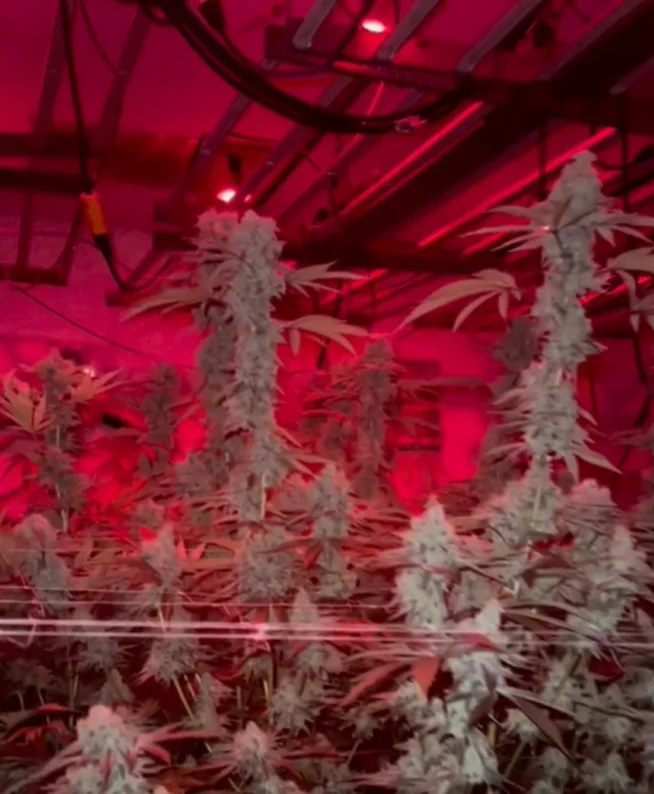
A 2021 study of ornamental annuals investigated supplemental far-red at 15 µmol m⁻² s⁻¹. The researchers found that far-red supplementation during the later part of seedling production could advance flowering in selected long-day crops. Depending on the species and treatment, the time to visible flower was reduced by up to three days in calibrachoa and eight days in snapdragon compared with certain comparison lighting treatments. The researchers recommended at least 14 days of far-red exposure before transplanting for the long-day crops studied. These results support the use of far-red as a crop-development tool, but they do not establish a universal treatment for all flowering plants.
What does research say about the ideal R:FR ratio?
There is no single R:FR ratio that reliably accelerates flowering in every crop.
A useful example comes from a study by Yamada et al. (2009) on Eustoma grandiflorum ‘Nail Peach Neo’. The researchers examined different red-to-far-red ratios using red radiation around 660 nm and far-red radiation around 730 nm. Under their experimental conditions, a ratio near 5.3 marked a threshold separating flowering-promoting from flowering-delaying responses. The study also found that far-red intensity and night-break treatment influenced the time to visible bud.
That result is valuable, but it must be interpreted in context. It was obtained with a particular crop, cultivar, lighting setup, and treatment regime. It should not be treated as a target ratio for petunia, chrysanthemum, strawberry, or other unrelated crops.
A more useful approach is to identify a crop-specific response range by testing multiple R:FR treatments while keeping other growing conditions consistent.
Designing a far-red LED lighting protocol
A practical lighting protocol should control at least five variables: the red spectrum, far-red intensity, photoperiod, background PPFD, and duration of treatment.
Select the correct LED wavelengths
A practical starting setup may include:
Red LEDs centred around 660 nm.
Far-red LEDs centred around 730 nm.
Blue and broad-spectrum white light to support balanced growth.
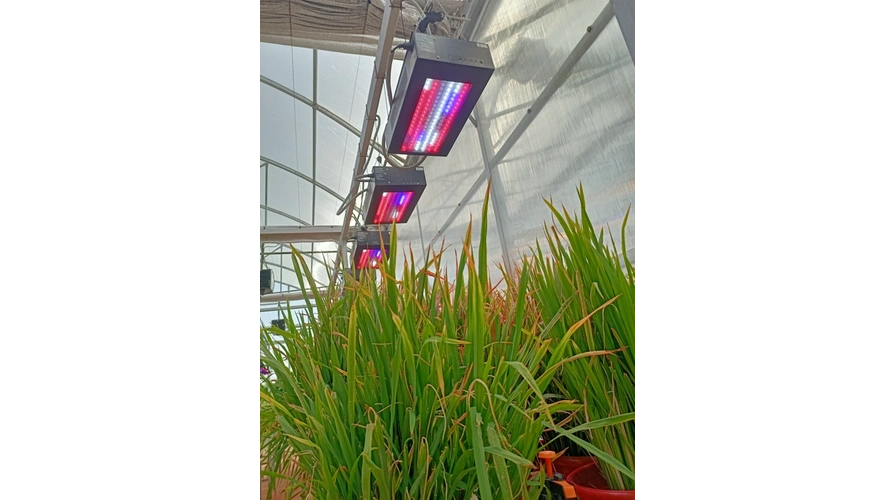
Dimming controls or independently controlled channels to adjust the far-red contribution.
The exact fixture specification should be based on measured photon output and the crop's requirements. A fixture described as “full spectrum” may contain very little far-red, so its spectral distribution should be checked rather than assumed.
Measure the light reaching the crop
Measure red and far-red photon flux at the plant canopy. Record the wavelength bands used to calculate R:FR, because different measurement definitions can produce different reported ratios.
Also record PPFD and DLI. Far-red photons are outside the conventional 400–700 nm PAR range, but they can contribute to photosynthesis when combined with shorter wavelengths. As a result, adding far-red may change both the developmental signal and the plant's effective light environment.
For a fair comparison, avoid increasing far-red while accidentally changing temperature, total photon delivery, or the background spectrum in ways that confound the results.
Use timing deliberately
Research supports testing far-red during defined developmental windows rather than assuming that continuous supplementation is always necessary. In the ornamental annual study described here, supplementation during seedling production was sufficient to influence subsequent flowering. The magnitude of the effect varied among crops.
For an untested crop, it is reasonable to compare a control treatment with defined far-red exposures during late vegetative growth, then assess whether the treatment changes flowering time without reducing plant quality. The precise duration and intensity should be established experimentally rather than copied directly from another species.
Risks and limitations of far-red supplementation
Far-red can be useful, but excessive or poorly timed exposure may create problems.
Excessive stem elongation: A low R:FR ratio can trigger shade-avoidance responses, including longer internodes and petioles. This may be undesirable in compact ornamental plants or crops that need strong stems.
Reduced plant quality: Far-red can change leaf development, branching and biomass allocation. Some responses may improve appearance, while others may reduce compactness or root growth.
Incorrect flowering response: Short-day plants, long-day plants and day-neutral plants do not necessarily respond in the same way. The effect may also differ between cultivars of the same species.
Inadequate photosynthetic light: Far-red should not be used as a replacement for sufficient photosynthetic lighting. Plants still require an appropriate supply of light for carbon assimilation and healthy growth.
Poorly defined ratios: A ratio without the corresponding photon fluxes, wavelength bands and treatment duration provides incomplete information. Two systems with the same R:FR ratio can produce different plant responses.
Research reviews of ornamental LED lighting emphasise that spectrum, timing and plant developmental stage should be considered together when designing flowering-control strategies.
Future applications in controlled-environment horticulture
Far-red LEDs create opportunities to make flowering control more precise. Instead of applying the same spectrum throughout the production cycle, growers can consider stage-specific lighting strategies:
During early vegetative growth, maintain a balanced spectrum that supports healthy canopy and root development.
During a crop-specific flowering-induction window, test far-red supplementation if research suggests that the species is responsive.
During flower development, reassess the spectrum and intensity to maintain stem quality, flower size and plant uniformity.
For commercial production, compare energy use, crop duration, flowering uniformity and saleable quality—not flowering time alone.
A particularly promising direction is the use of independently controlled red, blue and far-red LED channels linked to crop stage or sensor measurements. However, the best strategy will depend on species-specific photobiology and production objectives rather than one universal ratio.
Conclusion
Far-red LED supplementation can be an effective tool for influencing the transition from vegetative growth to flowering, particularly in selected long-day ornamental crops. By modifying the red-to-far-red ratio, growers can alter phytochrome signalling and potentially advance flowering. Experimental evidence from calibrachoa, snapdragon and lisianthus demonstrates that the response can be substantial under particular lighting conditions.
However, a lower R:FR ratio does not guarantee earlier flowering in every crop. Photoperiod, cultivar, background spectrum, treatment duration, light intensity and developmental stage all influence the outcome. The most reliable approach is to establish a crop-specific response through controlled trials, using visible bud date, first-flower date and marketable quality as key measurements.
Far-red lighting should therefore be treated as a targeted developmental-management tool within a balanced LED programme. When combined with adequate photosynthetic lighting and a suitable photoperiod, it can help growers investigate faster, more uniform flowering without sacrificing plant quality.
References
Bantis, F., Smirnakou, S., Ouzounis, T., Koukourikos, K., & Radoglou, K. (2018). Current status and recent achievements in the field of horticulture with the use of light-emitting diodes (LEDs). Scientia Horticulturae, 235, 437–451.
Jones, M. A. (2018). Using light to improve commercial value. Horticulture Research, 5, Article 47.
Duration of light-emitting diode (LED) supplemental lighting providing far-red radiation during seedling production influences subsequent time to flower of long-day annuals. (2021). Scientia Horticulturae, 281, Article 109956.
Yamada, A., Tanigawa, T., Suyama, T., Matsuno, T., & Kunitake, T. (2009). Red:far-red light ratio and far-red light integral promote or retard growth and flowering in Eustoma grandiflorum (Raf.) Shinn. Scientia Horticulturae, 120(1), 101–106.