UAE
UAE

The Blue: Red Ratio and Its Impact on Crop Breeding
Introduction
Speeding up plant breeding programs is important in view of climate change, population increase, and sustainable agriculture requirements (Mitchell et al., 2015). Conventional breeding techniques take a lot of time due to the fact that several generations are required to produce plants that possess all the desirable traits. Speed breeding has been made possible due to manipulation of certain environmental factors in order to reduce generation times (Mitchell et al., 2015). One of the environmental factors whose manipulation influences the rate of flowering and reproduction is light quality, especially the blue to red light ratio (Wang et al., 2022; Kong & Zheng, 2024).
LEDs and Precise Spectral Control
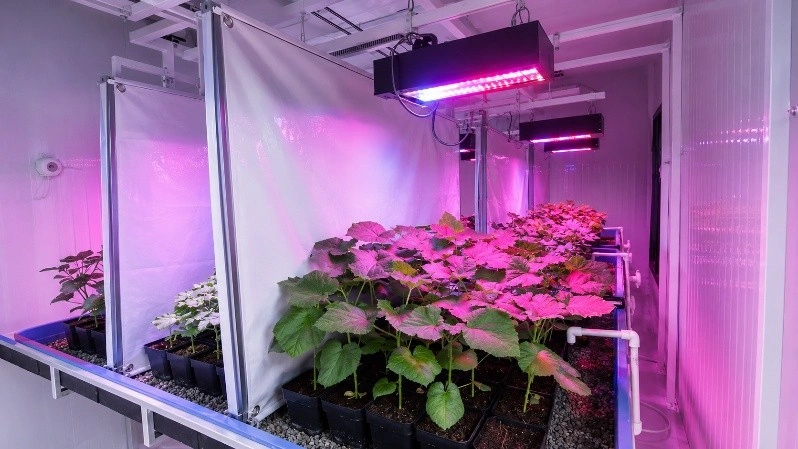
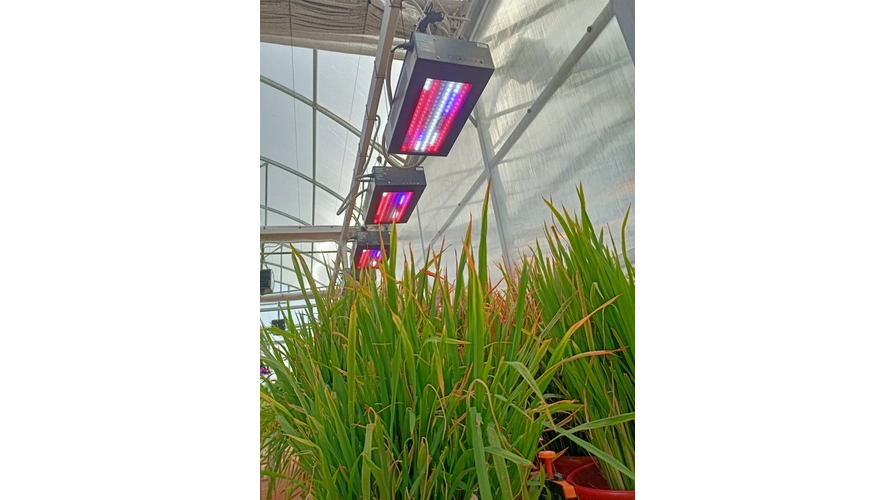
LEDs have provided a breakthrough in the field of horticultural lighting due to the precise management of spectral composition, intensity, and duration (Mitchell et al., 2015). In contrast to conventional lighting, LEDs are capable of emitting specific wavelengths that are targeted to stimulate certain photoreceptors in plants. In addition, blue-to-red (B:R) ratio control has proved extremely useful in terms of the regulation of flowering time, as both blue and red light play an important part in photoperiodic signalling and flowering induction (Kong & Zheng, 2024; Wang et al., 2022).
Scope of This Review
This review aims to synthesize current knowledge on how B:R ratios affect flowering time and reproductive development in crop plants, with particular emphasis on applications in breeding programs.
Discussion
One of the key environmental factors that play a vital role in determining plant growth and reproduction in controlled environment agriculture is the ratio of blue to red light. Even though both red and blue lights are equally important for plants’ development, the ratio of the two is responsible for the allocation of resources of plants in vegetation or reproduction. In this regard, the optimization of the blue-to-red ratio became a critical factor in breeding programs and speed breeding.
How Blue and Red Light Signals Interact
While red light is responsible for controlling flowering via the phytochrome pathway, blue light affects the development of the plant via cryptochromes and phototropins, affecting photosynthesis, stomatal conductance, chlorophyll production, and photomorphogenesis. Instead of working independently, these photoreceptors work together to control the expression of the flowering genes, such as CONSTANS (CO), FLOWERING LOCUS T (FT), and LEAFY (LFY), responsible for controlling the process of transition from the vegetative to the reproductive stage. Thus, the physiological effect of LED lights will depend not only on the presence of red and blue light but also on their ratio.
Higher Blue Ratios Accelerate Flowering
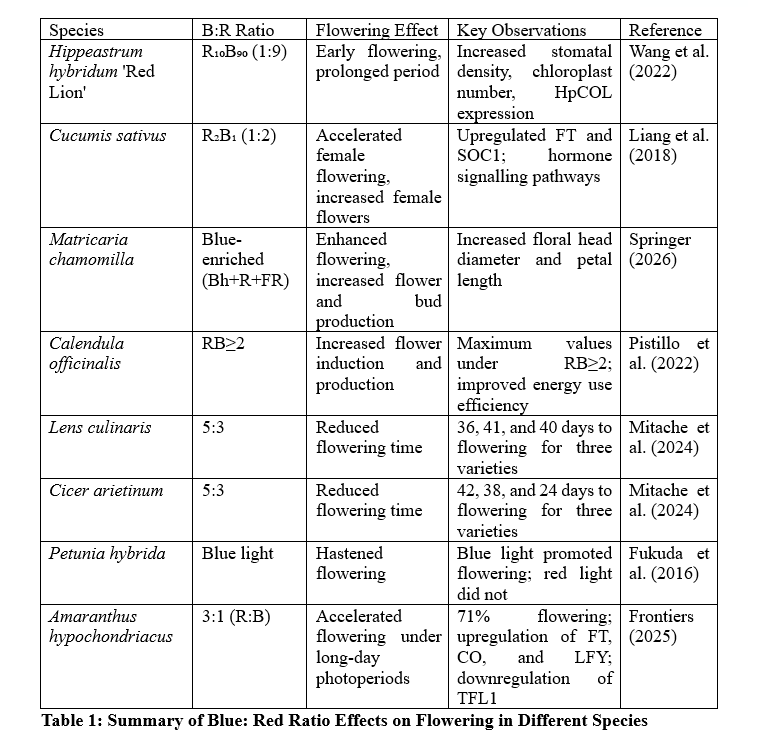
According to recent studies, an increase in the amount of blue light is expected to promote flowering and enhance photosynthetic efficiency at the same time. For instance, Wang et al. (2022) showed that the use of light with 90% blue and 10% red light (R10B90) accelerated the process of flowering, extended the flowering period, raised the amount of chlorophyll, stimulated photosynthesis, and improved chlorophyll fluorescence in Hippeastrum hybridum in comparison with light with a predominance of red light. At the same time, light with 90% red and 10% blue light (R90B10) led to the stimulation of vegetative growth, i.e., larger leaves and flower organs, but flowering started later.
Molecular Evidence: Flowering Gene Expression
Moreover, molecular data also reinforce the significance of blue-to-red ratios in the process of flowering regulation. The exposure of plants to the combination of red-blue LEDs caused the up-regulation of crucial flowering genes such as FT, LFY, CO, and CRY2. These genes play an important role in the process of the photoperiodic flowering pathway, and their up-regulation results in the accelerated flowering process despite the unfavourable conditions of photoperiod. Thus, the activation of phytochrome and cryptochrome signalling pathways contributes to the explanation of the observed enhanced flowering processes.
Implications for Plant Breeding
From a perspective of plant breeding, these results suggest that there is not an ideal blue to red ratio which can suit all types of plants. On the contrary, the ideal spectral composition would vary according to the physiology of the crops as well as the aims and developmental stage. A spectral composition favouring red would be beneficial in the early stages of growth since it would help in biomass production and development of the canopy, while an increased ratio of blue light in the reproductive phase would help in early flowering, more efficient photosynthesis, and flowering uniformity.
Overall, current evidence demonstrates that optimizing the blue-to-red LED ratio is an effective approach for manipulating plant architecture, photosynthetic performance, and flowering behaviour in controlled environments. Future research should focus on developing species-specific spectral recipes and dynamic lighting protocols that integrate spectral quality with photoperiod and light intensity to maximize breeding efficiency and crop productivity.
Regulation of the Circadian Clock
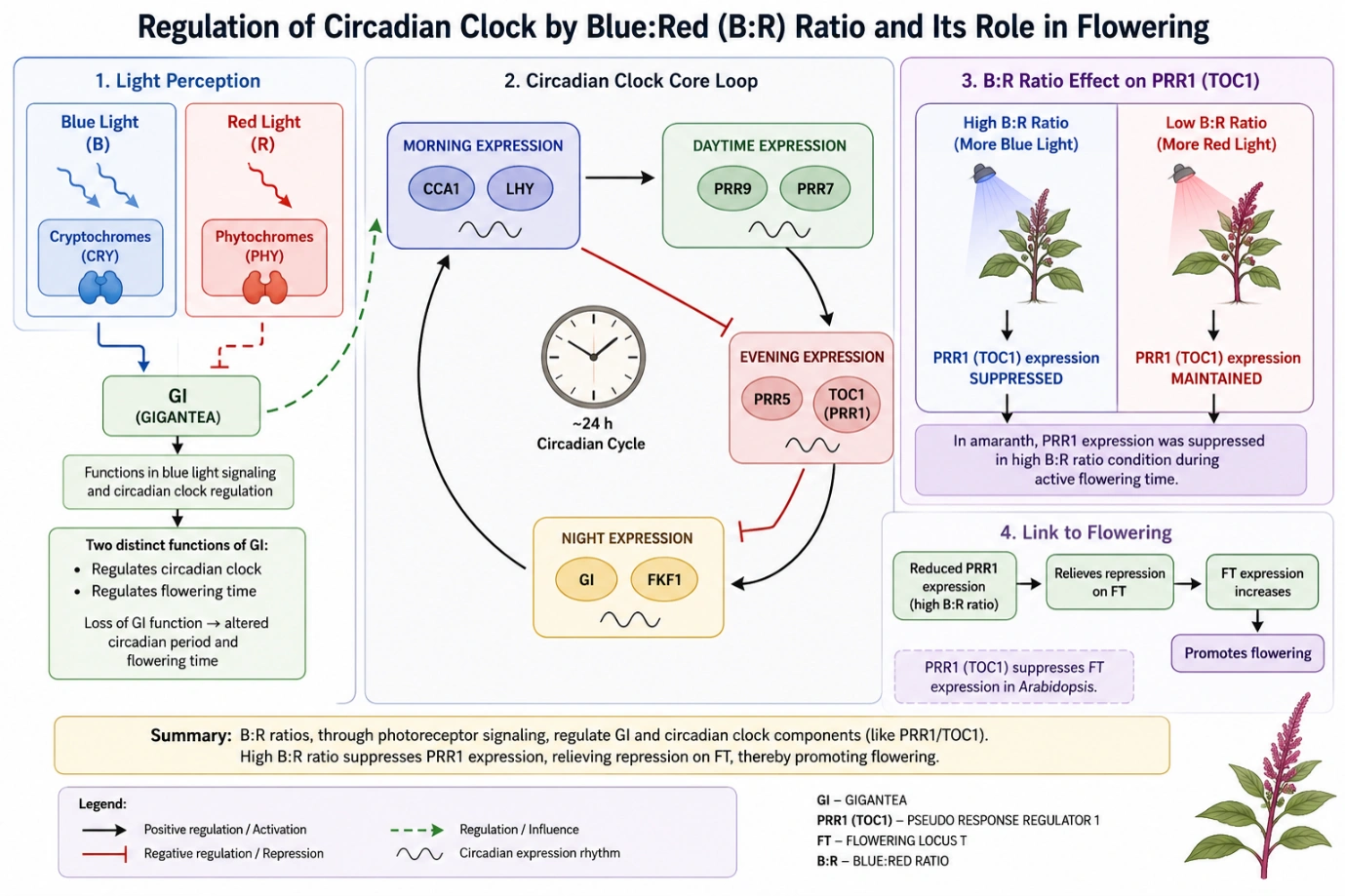
The circadian clock has an important function in photoperiodic flowering, and B:R ratios have the ability to affect circadian clock function through photoreceptor signalling (Kong & Zheng, 2024; Supplementary Data, 2025).
GIGANTEA and Blue-Light Clock Regulation
GI protein, which functions in blue light signalling and circadian clock regulation, has two distinct functions regarding circadian clock regulation and flowering time regulation (Supplementary Data, 2025). Mutations that lead to loss of GI function are known to change the circadian period and flowering time. This indicates that blue light-mediated circadian clock regulation is necessary for normal flowering time (Supplementary Data, 2025).
PRR1/TOC1 Response to B:R Ratio
PRR1 (PSEUDO RESPONSE REGULATOR 1), which is also called TOC1, is another component of the circadian clock that responds to B:R ratio (Frontiers, 2025). In amaranth, PRR1 expression was suppressed in high B:R ratio condition during active flowering time. This could imply that the FT release from repression is related to reduced PRR1 expression (Frontiers, 2025). This is supported by the fact that PRR1 suppresses FT expression in Arabidopsis.
Applications in Speed Breeding and Crop Improvement
Speed Breeding Protocols
Methods of speed breeding aimed at the manipulation of environmental factors that lead to a decrease in generation time have gained increasing significance in crop improvement programs (Mitchell et al., 2015; Mitache et al., 2024). Manipulation of B:R ratio is one of the core elements in many speed breeding protocols, since it can stimulate flowering and shorten the period needed for seed formation.
For instance, in soybean (Glycine max), the combination of red (80%) and blue (20%) LED light, as well as photothermal conditions, shortened the generation cycle by 56–66 days relative to normal field conditions and facilitated five generations per year (PMC, 2024).
In hot pepper (Capsicum spp.), the addition of low intensity of far-red light (30 µmol·m⁻²·s⁻¹, R:FR = 2.1) stimulated flowering and accelerated ripening of the pepper fruit, thus positively influencing seed germination rate (PMC, 2024).
Conclusion
The adjustment of blue-to-red (B:R) ratio through LED technology is now considered an effective strategy to control flowering time and increase breeding efficiency. Results of various studies have revealed that increased blue light ratio leads to early flowering in most species, whereas high red light ratio promotes the vegetative phase in plants. In addition, plant response to the change in B:R ratio varies depending on the species, and therefore requires specific adjustment in B:R ratio according to the crop and breeding aim.
The molecular basis of B:R-dependent flowering includes the interaction of cryptochrome and phytochrome signalling pathways, the regulation of flowering-related gene expression such as CO, FT, and LFY, and the modulation of hormone signalling and circadian rhythm functioning. The use of B:R ratio adjustment in speed breeding systems showed significant generation time shortening.
In future, studies need to be carried out in order to understand the mechanism behind species-specific B:R responses, improve B:R ratios for other crops as well, and integrate B:R manipulation with new technologies that can be used for precision breeding. It is imperative to develop light regimes for specific growth stages and implement them effectively in order to make the practice feasible.
References
Fukuda, N., Ishii, Y., Ezura, H., Olsen, J. E., & Christensen, L. P. (2016). Antagonistic action of blue and red light on shoot elongation in Petunia depends on gibberellin, but the effects on flowering are not generally linked to gibberellin. Environmental and Experimental Botany, 121, 102–111. https://doi.org/10.1016/j.envexpbot.2015.06.005
Kong, Y., & Zheng, Y. (2024). Diverse flowering response to blue light manipulation: Application of electric lighting in controlled-environment plant production. Horticulturae, 10(12), 1307. https://doi.org/10.3390/horticulturae10121307
Liang, Y., Zhang, X., Luo, H., Zhao, G., & Li, Z. (2018). Comparative RNA-Seq analysis on the regulation of cucumber sex differentiation under different ratios of blue and red light. Botanical Studies, 59, Article 21. https://doi.org/10.1186/s40529-018-0235-9
Mitache, M., Zeroual, A., Baidani, A., Bencharki, B., & Idrissi, O. (2024). Influence of red–blue light ratio on the phenology and morphology of different lentil (Lens culinaris Medik.) and chickpea (Cicer arietinum L.) genotypes under a simple and resource-efficient in-house speed breeding method based on the application of extended photoperiod. Plant Breeding, 143(6), 773–784. https://doi.org/10.1111/pbr.13290
Mitchell, C. A., Both, A. J., Bourget, C. M., Burr, J. F., Kubota, C., Lopez, R. G., Morrow, R. C., & Runkle, E. S. (2015). Light-emitting diodes in horticulture. Horticultural Reviews, 43, 1–87. https://doi.org/10.1002/9781119107781.ch01
Pistillo, A., Pennisi, G., Crepaldi, A., Giorgioni, M. E., Minelli, A., Orsini, F., & Gianquinto, G. (2022). Influence of red:blue ratio in LED lighting for indoor cultivation of edible marigold flowers. Acta Horticulturae, 1337, 249–254. https://doi.org/10.17660/ActaHortic.2022.1337.32
Wang, S., Liu, X., Liu, X., Xue, J., Ren, X., Zhai, Y., & Zhang, X. (2022). The red/blue light ratios from light-emitting diodes affect growth and flower quality of Hippeastrum hybridum ‘Red Lion’. Frontiers in Plant Science, 13, Article 1048770. https://doi.org/10.3389/fpls.2022.1048770