UAE
UAE

Effects of Far-Red Light on Flowering
Introduction
Light is among the most important factors controlling plant development and productivity. Apart from being the source of energy for photosynthesis, light acts as a signal controlling virtually all aspects of plant development, including seed germination, flowering, and fruit ripening (Demotes-Mainard et al., 2016). The spectrum of light, specifically the ratio between red (R) (600–700 nm) and far-red (FR) (700–800 nm) radiation, allows plants to obtain environmental information, including the distance between vegetation and light qualities (Casal, 2013).
How Plants Sense Red and Far-Red Light
Red to far-red ratio is detected by the phytochrome group of receptors, which have two forms – the inactive PR form and the active PFR form. Red light converts PR to PFR, and far-red light converts PFR to PR (Chen & Chory, 2011). Phytochrome photo-stationary-state (PSS) is defined as the ratio of active PFR to the total phytochrome and represents the quantitative light quality information obtained by plants (Sager et al., 1988). The PSS is around 0.70 in natural daylight. Yet, because of the common use of red-blue LEDs in agriculture, which emit little FR light, the PSS is much higher than the PSS of natural daylight (Kalaitzoglou et al., 2019).
Scope of This Review
This review aims to synthesize current knowledge on the effects of FR light on flowering and fruit production in horticultural crops, with a focus on tomato and sweet pepper. We discuss the mechanisms underlying FR-mediated effects on plant morphology, assimilate partitioning, carbohydrate metabolism, and hormonal regulation, and consider the practical implications for greenhouse lighting management.
Effect of Far-Red Light on Flowering
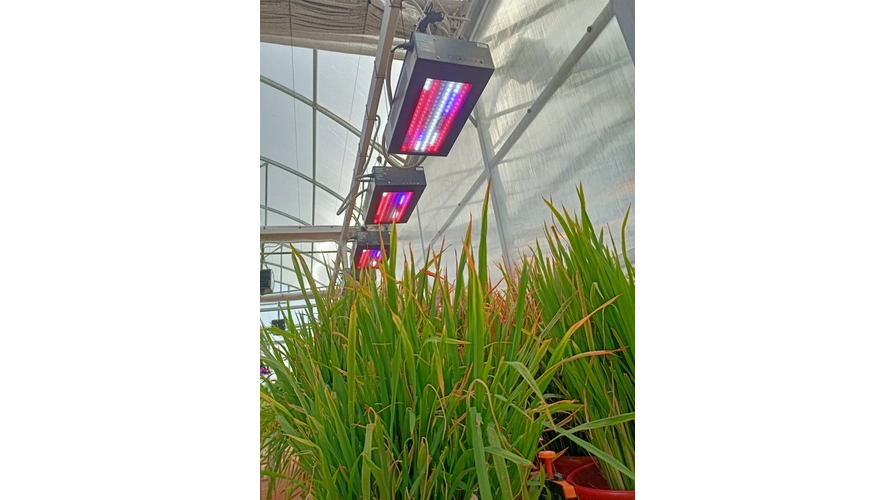
Far-red (FR; 700–750 nm) light is crucial in flower control through alteration of the photo-equilibrium of phytochromes, the major photoreceptor that senses light quality and photoperiod changes. Far-red light affects the expression of floral-inducing genes by transforming the active phytochrome (PFR) into inactive phytochrome (PR). Far-red light, therefore, acts as an environmental signal controlling the switch from the vegetative to the reproductive phase transition (Trivellini et al., 2023; Teja et al., 2026).
Photoperiodism Determines the Flowering Response
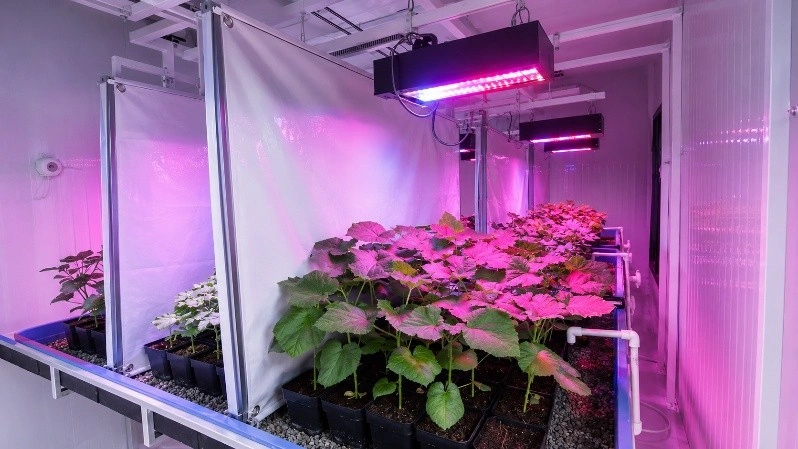
The flowering effect of far-red light depends on the photoperiodism characteristic of different plants. For long-day plants, application of far-red light results in early flowering since far-red light lengthens the photoperiod and facilitates photoperiodic signal transduction pathways. Meng and Runkle (2024) found that red and far-red light (R + FR) LED lighting increased flowering rates in various long-day ornamental species like snapdragon and petunia, whether provided after dusk, before dawn, or at night-interruption stages. The results show that far-red light manipulation can easily regulate flowering times in controlled environments (Meng & Runkle, 2024).
Effects Beyond Flowering: Morphology and Canopy Structure
However, the impact of far-red light on plants goes beyond flowering. The application of supplemental far-red lighting leads to an increase in stem elongation, leaf expansion, and better canopy structure, which enhances light interception and photosynthesis in plants. While the above effects contribute to increased reproductive growth of the plant, too much far-red exposure causes shade-avoidance traits that lead to decreased compactness of the plant. As such, the use of far-red lighting should be balanced with other lights, especially red and blue lights, to ensure that flowering is promoted without compromising the plant’s morphology (Trivellini et al., 2023; Teja et al., 2026).
Key Takeaways on Far-Red and Flowering
In conclusion, existing research indicates that far-red light is an important element of LED lighting systems for flower induction. However, its effect is dependent on the species’ photoperiodism response, timing of exposure, and interaction with other environmental factors like light intensity and photoperiod. Thus, optimization of far-red exposure should be done through species-specific
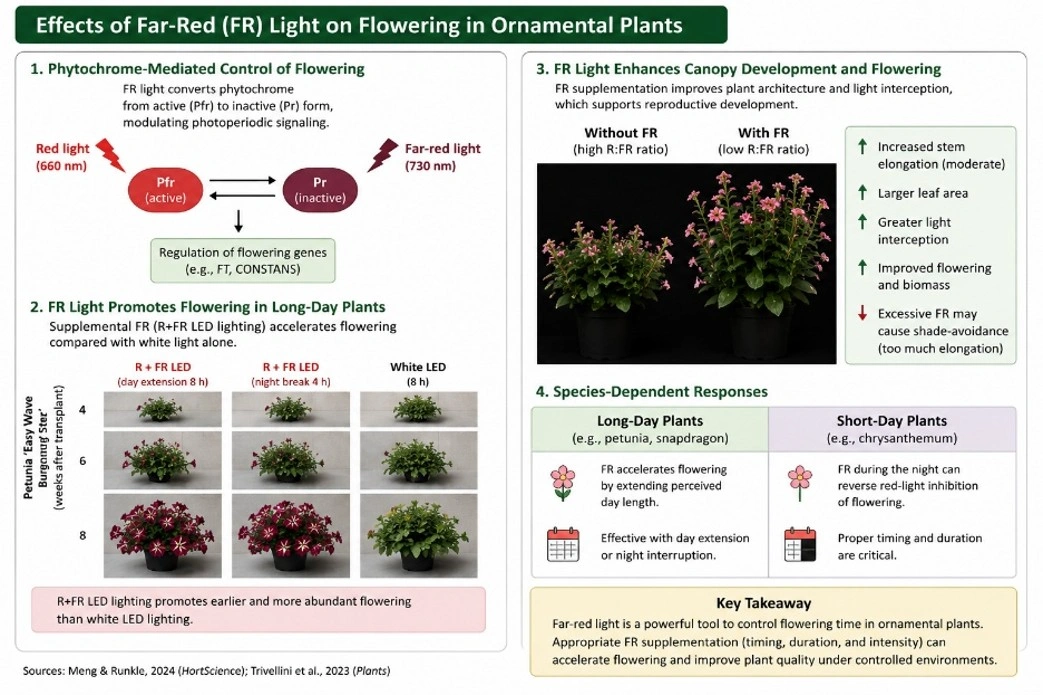
lighting strategies that will promote efficient flowering while still maintaining plant quality (Meng & Runkle, 2024; Trivellini et al., 2023; Teja et al., 2026).
Discussion
Literature clearly shows that far-red light is not just an accessory wavelength, but rather a very important regulator of flowering in controlled environment growing systems. This is due to the fact that far-red light is capable of affecting phytochrome-mediated photoperiodic signaling and thus can affect the timing of floral induction. The strength and direction of the response, however, will depend on the species, photoperiodism type, and how far-red light is used within the lighting regimen.
Evidence from Long-Day Ornamentals
It is clear that in long-day ornamental plants, the use of both red and far-red LEDs will result in greater flowering than white light. Meng and Runkle (2024) found out that red plus far-red LED lamps helped flowers bloom earlier in snapdragons and petunias than the warm-white LEDs, especially in the case of extended day lighting. The researchers found out that the duration of the far-red light had significance too, since 8-hour far-red day-extension lighting worked better than night-break lighting.
Balancing Flowering Gains Against Plant Compactness
This conclusion is further backed up by a comprehensive review of the scientific literature, which stresses the fact that lack of far-red leads to the delay of flowering in many long-day ornamentals, whereas adding far-red helps to restore reproductive growth. In addition to being involved in floral induction, far-red facilitates canopy development and light capture due to stem and leaf elongation and, hence, indirectly enhances the photosynthesis necessary for reproduction. However, too much far-red can result in strong shade-avoidance responses that lead to undesirable internode elongation and poor plant compactness. Thus, the consideration of both factors is needed when developing a strategy of LED lighting.
Interaction with Other Environmental Factors
Finally, there is evidence that far-red lighting cannot be considered separately from other environmental factors. Interactions of far-red effects with photoperiod, daily light integral, light intensity, and spectrum should be considered. Balanced ratios of red, blue, and far-red spectra usually give better results in flowering induction compared to monochromatic lighting, since they help to coordinate the functioning of phytochromes, cryptochromes, and photosynthesis.
The Case for Crop-Specific Optimisation
On balance, from the literature that is currently available, it is clear that the use of far-red lighting needs to be optimized for different crops, rather than applying a common formula across all plants. Long-day crops can take advantage of far-red light to improve their flowering and reproductive performance. Short-day crops, on the other hand, need to have far-red light properly timed to maintain proper photoperiodic responses. Future work should concentrate on finding the far-red requirements for each specific crop, as well as the appropriate timing of far-red lighting during plant growth.
Crop-Specific Effects of Far-Red Light
FR is an important environmental cue, which significantly impacts flowering and fruiting in horticultural crops. FR mediates changes in the plant through phytochrome-based signalling in terms of morphology, assimilate partitioning, carbon metabolism, and hormonal balance.
Far-Red Light in Tomato
The role of FR in tomatoes consists of stimulation of growth and fruiting due to increased leaf area, light interception, and source strength. Lack of FR in red-blue LED lighting results in an inverse shade-avoidance reaction, decreasing productivity. Constant FR application during the day is more effective than EOD-FR in this respect.
Far-Red Light in Sweet Pepper
For sweet pepper, the effects of FR are quite complicated. Although FR stimulates vegetative growth and light interception, it promotes apical dominance and flower and fruit abortion. The mechanism of these effects is associated with increased competition of assimilates between the apical shoots and flowers, with lower sucrose transport and invertase activity in flowers playing the leading role. The experiment with decapitation showed the necessity of the presence of shoot apices in the FR effect on abortion.
Conclusion
These different effects emphasize the importance of a species-specific approach in terms of lighting in horticulture. Thus, FR supplementation may be recommended for tomatoes. For pepper, careful management of FR is required to balance vegetative growth and reproductive success. Future research should focus on understanding the molecular mechanisms underlying these responses and developing strategies to optimize FR application for different crops and growing conditions.
References
Chen, M., & Chory, J. (2011). Phytochrome signaling mechanisms and the control of plant development. Trends in Cell Biology, 21(11), 664–671. https://doi.org/10.1016/j.tcb.2011.07.002
Demotes-Mainard, S., Péron, T., Corot, A., Bertheloot, J., Le Gourrierec, J., Pelleschi-Travier, S., Crespel, L., Huché-Thélier, L., Morel, P., Boumaza, R., Vian, A., Guérin, V., Leduc, N., & Sakr, S. (2016). Plant responses to red and far-red lights, applications in horticulture. Environmental and Experimental Botany, 121, 4–21. https://doi.org/10.1016/j.envexpbot.2015.05.010
Kalaitzoglou, P., van Ieperen, W., Harbinson, J., van der Meer, M., Martinakos, S., Weerheim, K., Nicole, C. C. S., & Marcelis, L. F. M. (2019). Effects of continuous or end-of-day far-red light on tomato plant growth, morphology, light absorption, and fruit production. Frontiers in Plant Science, 10, Article 322. https://doi.org/10.3389/fpls.2019.00322
Meng, Q., & Runkle, E. S. (2024). Warm-white versus red plus far-red LED lamps at different nighttime timings regulate flowering of long-day plants. HortScience, 59(6), 767–775.
Teja, V. S., PS, L., T., S., Muradi, K. B., Sravya, N., Khatana, J. P., Totawar, H. M., Keshavrao, C. B., Babarao, D. S., & Wayal, Y. V. (2026). Role of LED lighting and light spectrum management in growth, flowering, and quality of ornamental plants. International Journal of Horticulture and Food Science, 8(1), 11–21. https://doi.org/10.33545/26631067.2026.v8.i2a.478
Trivellini, A., Toscano, S., Romano, D., & Ferrante, A. (2023). LED lighting to produce high-quality ornamental plants. Plants, 12(8), Article 1667. https://doi.org/10.3390/plants12081667